AI for Content Marketing: The Complete Guide for 2026
Artificial Intelligence (AI) has transformed content marketing from an optional advantage into a business necessity. Today, almost every successful marketing team uses AI in some way, but the real difference lies in how effectively they use it. Simply generating content with AI is no longer enough. Businesses that combine AI with strategic planning and human expertise consistently outperform those that rely solely on automation.
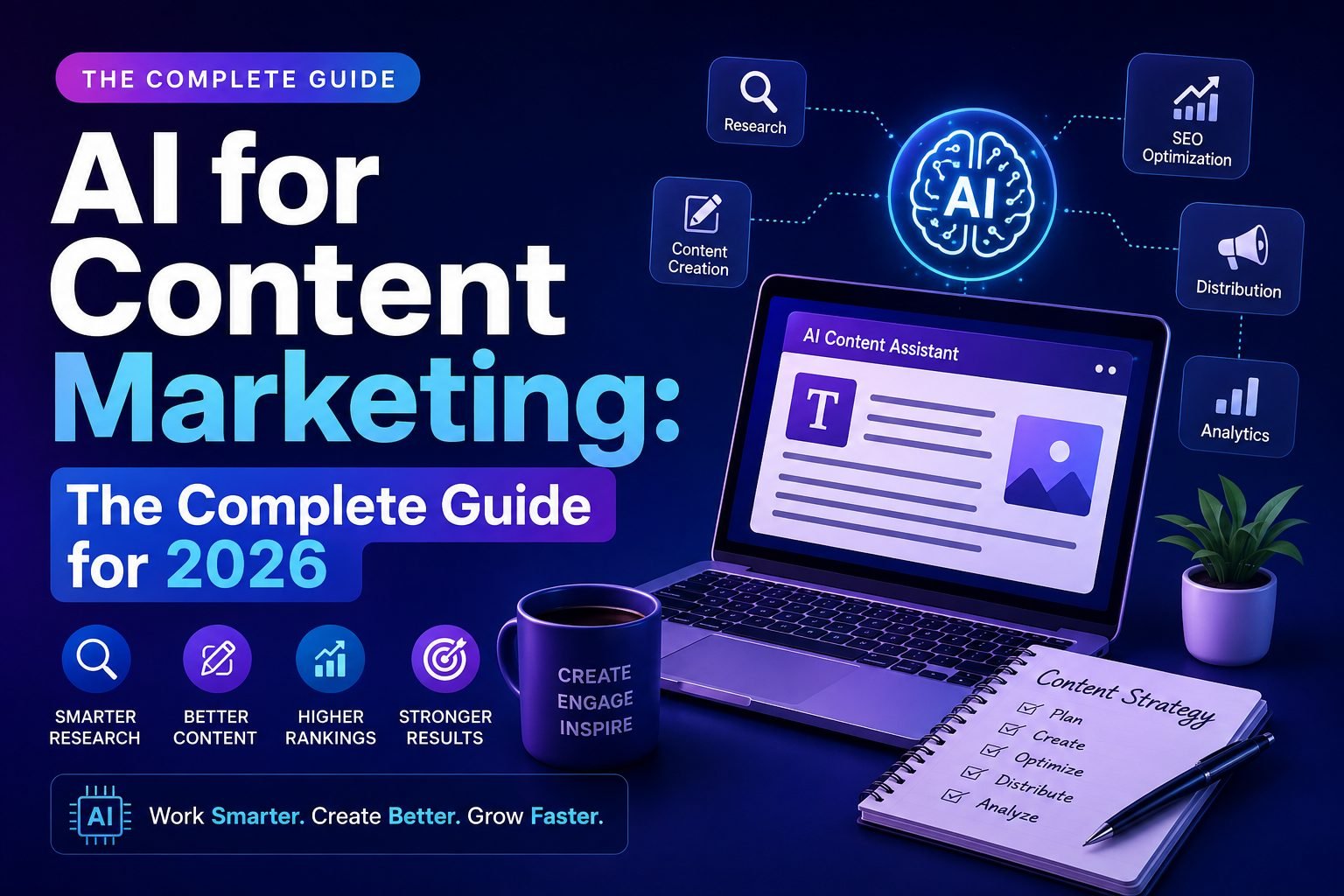
Modern AI tools can accelerate nearly every stage of the content marketing process. From discovering trending topics and researching competitors to drafting articles, optimizing content for SEO, repurposing blogs into social media posts and analyzing campaign performance, AI significantly reduces manual work while improving productivity.
However, producing more content doesn’t automatically mean producing better content. As AI makes publishing easier, competition grows stronger. Generic, AI-generated articles without originality or expertise rarely stand out in search results or engage readers. Successful brands use AI as a productivity tool while relying on human creativity, industry knowledge, and strategic thinking to create content that delivers real value.
The true competitive advantage doesn’t come from using AI—it comes from building an efficient workflow that blends automation with expert decision-making. This guide explains how businesses can use AI to plan, create, optimize, distribute and measure high-performing content while maintaining quality and authenticity.
Key Takeaways
- AI enhances every stage of the content marketing process, including research, planning, writing, optimization, promotion, and analytics.
- Human expertise remains essential for strategy, creativity, fact-checking, storytelling, and maintaining a consistent brand voice.
- Google does not penalize content simply because AI was involved in creating it. What matters most is originality, quality, usefulness, and user experience.
- Businesses achieve the best results when AI supports human marketers instead of replacing them.
- Choosing the right AI tools and measuring their impact helps companies scale content production while maintaining quality and increasing return on investment.
What Is AI Content Marketing?
AI content marketing refers to the use of artificial intelligence technologies to improve every stage of the content creation processfrom initial research and planning to writing, optimization, publishing, promotion, and performance analysis.
Many people believe AI content marketing simply means asking an AI chatbot to write a blog post. In reality, that’s only a small part of what AI can accomplish.
Modern AI platforms help marketers:
- Discover trending topics and customer interests
- Analyze competitors and identify content opportunities
- Generate detailed content briefs and outlines
- Create first drafts more efficiently
- Optimize articles for search engines
- Repurpose long-form content into social posts, emails, videos, and newsletters
- Track campaign performance and identify improvement opportunities
Instead of replacing marketers, AI eliminates repetitive tasks, allowing teams to spend more time on strategic planning, creativity, audience engagement, and business growth.
The most successful organizations don’t use AI simply to publish more articles. They use it to build smarter workflows that consistently deliver high-quality content aligned with business goals.
Traditional Content Marketing vs AI-Powered Content Marketing
| Traditional Content Marketing | AI-Powered Content Marketing |
|---|---|
| Manual keyword and audience research | AI-assisted market research and insights |
| Time-consuming content planning | AI-generated content briefs and outlines |
| Writing every article from scratch | AI-assisted drafting with human editing |
| One content asset per campaign | Easy repurposing into multiple formats |
| Manual reporting and analysis | AI-powered analytics and optimization |
AI doesn’t eliminate the need for human marketers—it makes them faster, more efficient, and more data-driven.
Why AI and Content Marketing Are Now Connected
Artificial Intelligence has become a core component of modern content marketing. Industry reports show that the overwhelming majority of marketers now incorporate AI into their workflows, and adoption continues to grow each year.
One of AI’s greatest advantages is its ability to dramatically improve productivity. A small content team can now produce the same amount of work that previously required several additional employees. This reduction in production time allows businesses to publish more consistently without significantly increasing costs.
Content marketing has always been one of the most cost-effective digital marketing strategies. AI amplifies that advantage by making research, drafting, editing, and optimization much faster while allowing marketers to focus on strategy and creativity.
Businesses that successfully combine AI efficiency with human expertise gain a significant competitive advantage over companies that rely entirely on manual processes or publish unedited AI-generated content.
Best AI Tools for Content Marketing in 2026
Choosing the right AI tools can dramatically improve your content marketing workflow. Instead of relying on one platform for everything, successful marketers build a stack of specialized AI tools for research, writing, SEO, design, automation, and analytics. Below are some of the best AI content marketing tools in 2026.
1. ChatGPT – Best Overall AI Writing Assistant
Best for: Content creation, brainstorming, blog writing, email marketing, social media content, and coding.
ChatGPT remains one of the most powerful AI assistants for marketers. It helps generate blog posts, product descriptions, landing pages, ad copy, email campaigns, FAQs, and content ideas within minutes. Combined with strong prompting and human editing, it significantly reduces content production time.
Key Features
- Long-form article writing
- SEO content outlines
- Content repurposing
- Email marketing copy
- Social media captions
- Coding and automation support
2. Claude AI – Best for Long-Form Content
Best for: In-depth articles, reports, ebooks, and technical documentation.
Claude AI excels at producing natural, well-structured long-form content. It follows instructions accurately, maintains context over long conversations, and creates human-like writing that’s ideal for professional blogs and documentation.
Key Features
- Large context window
- Human-like writing
- Excellent summarization
- Research assistance
- High-quality editing
3. Gemini – Best for Google Workspace Users
Best for: Research, productivity, Google Docs, Gmail, and Sheets.
Gemini integrates seamlessly with Google’s ecosystem, allowing marketers to generate content, summarize documents, analyze spreadsheets, and streamline workflows directly within Google Workspace.
Key Features
- Google Search integration
- Gmail assistance
- Google Docs support
- Data analysis
- Content brainstorming
4. Jasper AI – Best for Marketing Teams
Best for: Brand-consistent marketing content.
Jasper AI is designed specifically for businesses that produce high volumes of marketing content. It supports multiple brand voices, templates, and team collaboration features.
Key Features
- Brand Voice
- Marketing templates
- Campaign creation
- Team collaboration
- AI image generation
5. Surfer SEO – Best for AI SEO Optimization
Best for: On-page SEO optimization.
Surfer SEO analyzes top-ranking pages and provides actionable recommendations to improve keyword usage, headings, content length, semantic terms and overall search optimization.
Key Features
- Content Score
- NLP keyword suggestions
- SERP analysis
- Internal linking recommendations
- Competitor analysis
6. Semrush Content Toolkit – Best for Complete SEO Research
Best for: Keyword research and competitor analysis.
Semrush helps marketers discover profitable keywords, analyze competitors, track rankings, perform technical audits, and optimize content for better visibility.
Key Features
- Keyword Magic Tool
- Site Audit
- Position Tracking
- Backlink Analysis
- Content Marketing Platform
7. Ahrefs – Best for Content Gap Analysis
Best for: Organic traffic growth.
Ahrefs enables marketers to identify content gaps, discover backlink opportunities, monitor competitors, and uncover keywords with strong ranking potential.
Key Features
- Keyword Explorer
- Site Explorer
- Content Gap
- Backlink Checker
- Rank Tracker
8. Grammarly – Best AI Writing Editor
Best for: Grammar, clarity, and readability.
Grammarly improves grammar, spelling, sentence structure, tone, and readability, ensuring every piece of content is polished before publication.
Key Features
- Grammar correction
- Tone suggestions
- Readability improvements
- Plagiarism detection
- AI rewriting
9. Canva Magic Studio – Best for Visual Content
Best for: Marketing graphics and social media design.
Canva’s AI-powered Magic Studio helps marketers create blog graphics, presentations, infographics, banners, advertisements, and social media visuals without professional design experience.
Key Features
- AI image generation
- Magic Design
- Background remover
- Brand Kit
- Social media templates
10. Perplexity AI – Best Research Assistant
Best for: Fact-checking and research.
Perplexity AI provides accurate, citation-based answers, making it an excellent tool for researching topics, verifying information, and finding trustworthy sources.
Key Features
- Real-time research
- Source citations
- Web search
- Content inspiration
- Competitive research
Recommended AI Content Marketing Stack
| Task | Best Tool |
|---|---|
| Keyword Research | Semrush, Ahrefs |
| Topic Research | Perplexity AI, ChatGPT |
| Long-Form Writing | Claude AI, ChatGPT |
| SEO Optimization | Surfer SEO |
| Grammar & Editing | Grammarly |
| Image Creation | Canva Magic Studio |
| Content Repurposing | ChatGPT |
| Social Media Content | Jasper AI |
| Analytics | Google Analytics 4, Semrush |
| Workflow Automation | Zapier, Make, n8n |
Which AI Tool Is Best?
There is no single AI tool that excels at every stage of content marketing. The most effective approach is to combine specialized tools into a streamlined workflow. For example:
- Use Semrush to identify keywords and content opportunities.
- Research the topic with Perplexity AI.
- Draft the article using Claude AI or ChatGPT.
- Optimize the content with Surfer SEO.
- Edit and refine it with Grammarly.
- Create visuals in Canva Magic Studio.
- Automate publishing and promotion with n8n, Zapier, or Make.
By combining these tools, marketers can create high-quality, SEO-friendly content faster while maintaining originality, accuracy, and a consistent brand voice.
Conclusion
Artificial intelligence has fundamentally changed the way businesses approach content marketing. From keyword research and content planning to SEO optimization, content creation, distribution, and performance analysis, AI helps marketers work smarter, produce higher-quality content faster, and scale their marketing efforts more efficiently. However, the most successful content strategies combine the speed of AI with human creativity, expertise, and strategic thinking to create valuable, trustworthy content that resonates with audiences and performs well in search engines.
As AI technology continues to evolve, staying updated with the latest tools and best practices will be essential for maintaining a competitive edge. Whether you’re a blogger, digital marketer, agency owner, or business leader, adopting the right AI-powered workflow can improve productivity, increase organic traffic, and deliver better marketing results.
If you’re looking to discover the newest and most powerful AI solutions, Latest AI Tool is one of the best platforms to explore. It features a carefully curated collection of AI tools for content writing, SEO, marketing, automation, design, productivity, coding, video creation, and much more. With regularly updated tool listings, detailed reviews, practical guides, and expert recommendations, Latest AI Tool makes it easy to find the perfect AI solutions to streamline your workflow, boost efficiency and stay ahead in the rapidly evolving AI landscape.
What is AI for content marketing?
AI for content marketing is the use of artificial intelligence to assist with content planning, keyword research, writing, SEO optimization, content repurposing, distribution, and performance analysis. It helps marketers create high-quality content faster while improving productivity and efficiency.
Does Google penalize AI-generated content?
No. Google does not penalize content simply because it is AI-generated. Google’s focus is on content quality, originality, accuracy, and usefulness. AI-assisted content that provides value and is reviewed by humans can rank just as well as traditionally written content.
Can AI replace human content writers?
AI is a powerful assistant, but it cannot fully replace human writers. While AI can generate drafts, outlines, and ideas, human expertise is essential for strategic planning, storytelling, fact-checking, creativity, and maintaining a unique brand voice.
What are the best AI tools for content marketing in 2026?
Some of the best AI content marketing tools in 2026 include ChatGPT, Claude AI, Gemini, Jasper AI, Surfer SEO, Semrush, Ahrefs, Grammarly, Canva Magic Studio, and Perplexity AI. Each tool specializes in different tasks such as content creation, SEO, research, editing, and automation.
How can AI improve content marketing performance?
AI improves content marketing by automating repetitive tasks, generating content ideas, optimizing articles for SEO, analyzing audience behavior, repurposing content across multiple platforms, and providing data-driven insights. This enables marketing teams to publish more consistently while maintaining quality.
How do I create an effective AI-powered content marketing workflow?
An effective AI content marketing workflow begins with keyword and competitor research, followed by AI-assisted content planning and drafting. Afterward, human editors should fact-check, refine, and optimize the content for SEO before publishing. Finally, AI tools can help distribute the content, repurpose it into different formats, and track performance to improve future campaigns.